Sections & fields
SEK has a small vocabulary, and four words carry most of it: section type, section, field type, and field. The distinction in each pair is the same one: a reusable definition versus a placed instance that carries values.
Section type vs section
Section titled “Section type vs section”A section type is a definition. It is the blocks/<handle>.yaml config plus
its template: a named, reusable kind of section (a hero, a testimonial, a
pricing table). It lives in your theme, in git, and it declares what fields the
section type has and how it renders. It carries no content of its own.
A section (a section instance) is one placement of a section type on a
page, with values filled in. Add the promo section type to a page twice and
you have two sections: same definition, different headlines. Their values are
stored in that page’s _sek_data; the definition they share stays in
promo.yaml.
One
hero.yaml(section type) → many hero sections across many pages, each with its own headline and image.
Section instances can nest. A section type whose config uses a children or
sections field can contain other sections, to arbitrary depth: a layout
section holding columns, each column holding content sections. There is no fixed
“place sections live”; they live wherever the config puts them.
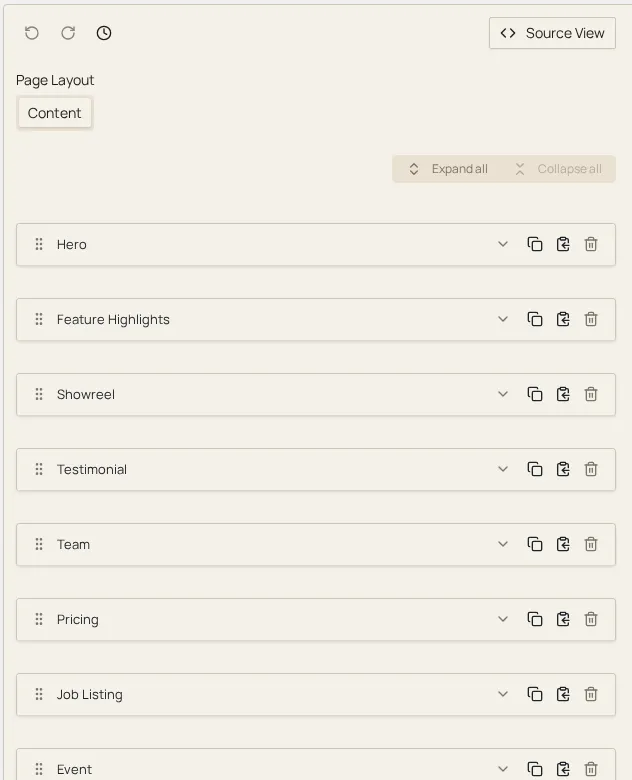
In the editor, a page’s section instances stack as a list of cards. Each row below is one instance of a section type, with its own values:
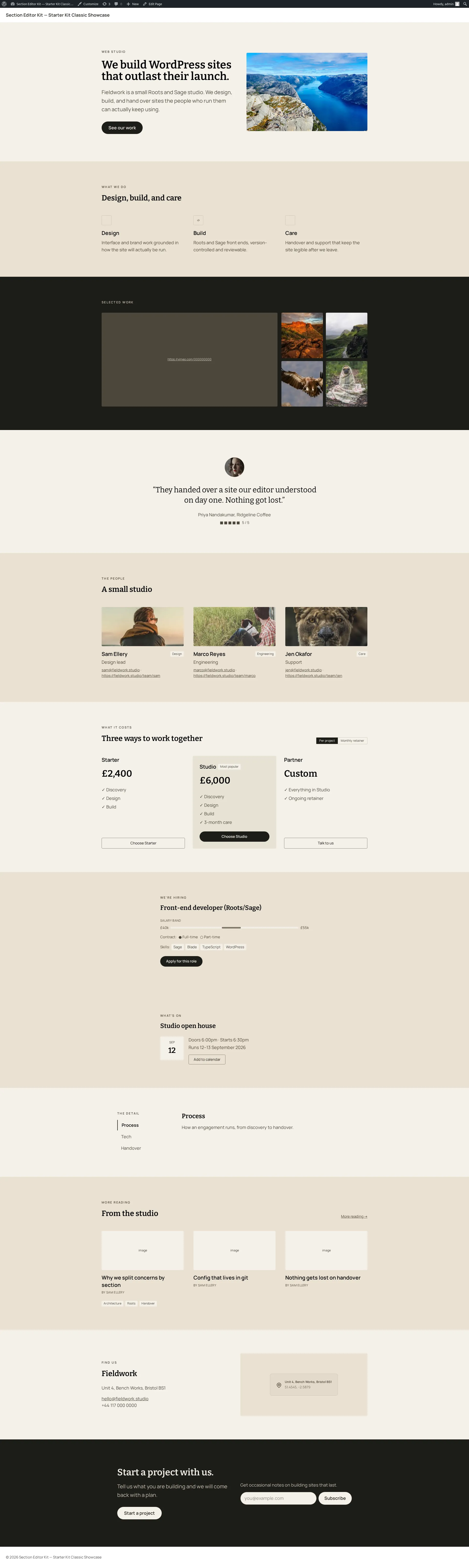
And on the front end, a section instance renders through its section type’s
template with its own values filled in. Here’s a hero section instance
rendered live:
Field type vs field
Section titled “Field type vs field”A field type is a reusable kind of input: text, wysiwyg, image,
select, link, and so on. Each field type knows how to render its editing UI,
what shape of value it stores, and what config options it accepts. There are
43 field types at the time of writing (the definitive list is generated from
source in the field-types catalogue: treat
that as the count, not any number frozen into prose here).
A field is one entry in a section type’s fields: list: a specific use of a
field type, with its own label, handle, and options. The promo section
type from the walkthrough has two fields, a headline of type text and an
intro of type wysiwyg:
fields: - label: Headline handle: headline type: text # ← field type - label: Intro handle: intro type: wysiwyg # ← field typeheadline and intro are the fields; text and wysiwyg are their field
types. The handle is how a field’s value is addressed everywhere: the
template reads $data['headline'], and reconciliation matches saved values to
config by handle.
How the pieces connect
Section titled “How the pieces connect”Putting both pairs together:
| Definition (in git) | Instance (values in the database) |
|---|---|
Section type: promo.yaml |
Section: a promo section on the About page |
Field type: text |
Field: the headline on that section |
The definitions are versioned code; the instances are content. Keeping those two apart is what lets SEK treat config as the source of truth and recover gracefully when a definition changes: see reconciliation and lost values.